Muamalah · 9 MIN READ
ROI and IRR in a profit-sharing investment: how much comes back, and how fast
A profit-sharing offer often comes with a projection such as "18% a year". Two different questions hide inside that number: how much money comes back in the end, and how quickly it comes back. ROI answers the first and IRR answers the second. In a mudharabah or musyarakah, neither is a rate anyone owes you; both are ways of reading a projection, and both change when the business does better or worse than planned.
Your share comes from a ratio, not a rate
In a mudharabah, investors provide the capital and a manager (the mudharib) provides the work. Profit is divided by a ratio agreed at the start, the nisbah, such as 60% for the investors and 40% for the manager. When several investors fund one project, the investors' part is usually divided among them by how much capital each put in. In a musyarakah, every partner contributes capital and each partner's profit ratio is agreed directly; it may differ from that partner's share of the capital, for example when one partner also does the work.
A fictional example: a project raises $50,000 and you put in $10,000, so your capital ratio is 20%. The projection is a profit of $18,000 over two years. With a 60% investors' nisbah, the investors' side receives $10,800, and your 20% of that is $2,160. The calculation is project profit × investors' nisbah × your capital ratio: 18,000 × 60% × 20% = 2,160.
Losses follow a different rule. An ordinary business loss is borne by capital, in proportion to each party's capital. In a mudharabah the manager loses the value of their work rather than money, unless the loss came from their negligence or a breach of the contract. That is why the profit ratio and the capital ratio must be kept apart: one divides profit, the other divides loss.
ROI: how much comes back
Return on investment compares what you gained with what you put in: ROI = (total received − capital) ÷ capital. In the example you put in $10,000 and receive $12,160 over the life of the project, so the ROI is 2,160 ÷ 10,000 = 21.6%.
ROI says nothing about time. A 21.6% ROI over two years is very different from 21.6% over five. Dividing by the number of years gives a rough yearly figure, 10.8% here, but that simple average still ignores when each payment actually arrives. Two projects with the same ROI and the same length can pay you very differently along the way.
ROI is therefore best read as the answer to one question only: if everything goes as projected, how much larger is the money that comes back than the money that went in?
IRR: how fast it comes back
The internal rate of return is the yearly rate that makes the whole stream of cash break even. Write your capital as a negative amount at the start and every payment you receive as a positive amount in the month it arrives. The IRR is the rate r at which the present value of all of them adds up to zero: −capital + Σ payment_t ÷ (1 + r)^t = 0. Spreadsheets solve this by trial; it assumes payments fall on regular periods, such as months, and a monthly rate becomes a yearly one through (1 + r)^12 − 1.
A clean example shows why timing matters. You put in $10,000 for twelve months and the profit is $1,200. If everything is paid at the end, you receive $11,200 after a year: ROI 12%, IRR 12%. If the same $1,200 is paid as $100 every month, with the capital returned at the end, the monthly IRR is exactly 1%, which is about 12.68% a year. Paid as $300 every quarter, it is 3% a quarter, about 12.55% a year. The ROI is 12% in all three cases.
The reason is simple: money that arrives earlier can be used earlier. The IRR rewards a schedule that pays sooner and penalises one that makes you wait, even when the total is identical. In finance the IRR is sometimes described as an "interest rate"; here it is only a way of measuring speed, not a charge on a loan.
The payout schedule and the grace period
Profit-sharing projects pay profit on a schedule: monthly, quarterly, yearly, only at the end, or in chosen months. A common way to model it is to let profit build up evenly each month and pay out whatever has built up since the previous payment, with the capital returned in the final month. In the two-year example, the same $2,160 gives an IRR of about 11.35% a year when paid monthly, 11.25% quarterly, 10.8% yearly and 10.27% if everything waits until the end.
Many real projects earn nothing at first while they are being set up. A grace period of six months, after which the same profit is earned over the remaining eighteen, leaves the ROI at 21.6% but lowers the monthly-paid IRR from about 11.35% to about 11.03%, because the first payments arrive later.
One more reading is the payback month: the first month in which everything you have received equals your capital. When the capital itself only comes back at the end, payback is the final month, however generous the interim payments look. Before investing, it is worth asking how often profit is paid, when the capital returns, and how profit already paid is treated at the final reckoning if a later period loses money; that last point is set by the contract, so read it there.
When the projection misses
A projection is a plan, not a result. If the project earns only half the projected profit, your share in the example falls to $1,080: ROI 10.8%, and with quarterly payouts an IRR of about 5.5% a year. The schedule cannot rescue a weaker business; it only changes how quickly whatever is earned reaches you.
If the project makes a loss, there is no profit to pay. Suppose the $50,000 project loses 10% of its capital, $5,000. Your capital ratio is 20%, so your share of the loss is $1,000 and $9,000 of your capital comes back: ROI −10%, an IRR of about −5.1% a year over the two years. The manager in a mudharabah bears none of that capital loss unless they were negligent, and the profit ratio plays no part in dividing it.
Testing a few scenarios, such as 150%, 100% and 50% of the projection, break-even, and a modest loss, gives a far more honest picture than a single headline rate.
A promised rate is a different contract
Because profit and loss follow the business, a genuine profit-sharing contract cannot promise a fixed return or guarantee the capital. If one side guarantees the other's capital in full, the arrangement turns into an interest-bearing loan, and the investor who bears no loss is no longer a partner but a lender. A profit fixed as an amount, such as "$1,000 for me whatever happens", is likewise not a valid profit share.
So an offer that says "capital protected, a sure 12% a year" is not describing mudharabah or musyarakah, whatever name it uses. A projected IRR is acceptable as a description of a plan; the same number written as a promise changes the nature of the deal. Islamic banks make the same distinction for deposits: an unguaranteed investment deposit shares real profit, while a guaranteed balance plus a fixed extra is, in substance, a loan with interest.
CHECK YOUR UNDERSTANDING
Practice on your own
- A $100,000 project projects $30,000 of profit over three years. The investors' nisbah is 70% and you put in $15,000. What is your projected share, and what is your ROI? (Check: 30,000 × 70% × 15% = $3,150; ROI 21%.)
- Two offers have the same 12% ROI over one year. One pays profit monthly, the other only at the end. Which has the higher IRR, and why does the ROI not tell them apart?
- The same $100,000 project loses 20% of its capital. With your $15,000 in it, how much capital comes back, and what is your ROI? Who bears the loss in a mudharabah if the manager was not negligent?
- An offer reads: "Profit sharing, capital guaranteed, 10% a year." Write down the two features that change its nature and what it becomes.
What to remember
Your share is project profit × the agreed ratio × your capital ratio; ROI tells you how much comes back and IRR how fast. Earlier payouts raise the IRR without changing the ROI, a grace period lowers it, and a loss reduces the capital that returns. A projected return is a reading of a plan; a guaranteed one is a loan.
Sources and notes
- OJK — Akad perbankan syariah: mudharabah and musyarakah (Indonesian)
- Microsoft Support — IRR function: definition and the regular-period assumption
Partnership rules (profit by the agreed ratio, loss by capital, no guaranteed capital or fixed-amount profit, and the deposit distinction) follow Dr. Yusuf Al Subaily, Fiqh Perbankan Syariah: Pengantar Fiqh Muamalat dan Aplikasinya dalam Ekonomi Modern, translated by Erwandi Tarmizi, pp. 53–86.
All dollar figures are fictional. The IRR values assume profit accrues evenly each month, payouts on the stated schedule and the capital returned in the final month; they were checked against closed forms, e.g. 1% a month gives (1.01)^12 − 1 ≈ 12.68% a year.
Where the material comes from
This article grew out of the Imajiedu learning material below. The credits name that material's references; they do not claim the referenced authors reviewed this article.
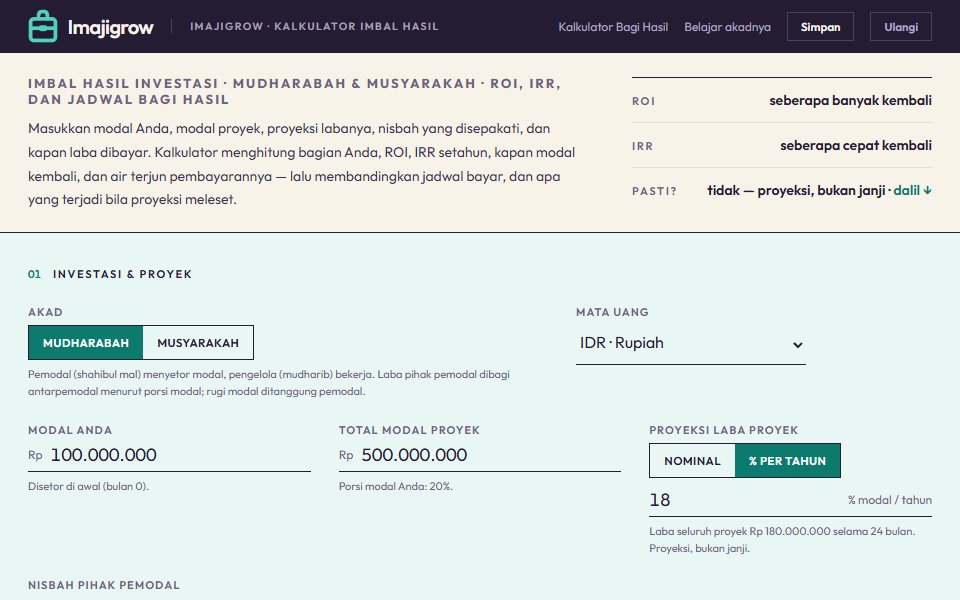
- Investment Return Calculator
Profit by ratio, loss by capital share, no guaranteed capital — partnership rules from Fiqh Perbankan Syariah (Al Subaily) pp. 53–86. ROI and IRR are projections, not promises. Not financial advice.
- Investment return
Exercises follow the assumptions and formulas in the linked calculator. Example figures are exercises only.
Written with AI assistance and not yet independently reviewed by an expert. Educational material, not a fatwa, professional advice or an emergency guide. Examples and assumptions do not guarantee real-world results. Read the editorial and corrections policy (Indonesian).
OPTIONAL PRACTICE · IMAJIEDU
Got the idea? Try it out.
Use the tools below to try the article's ideas with your own figures. This practice is optional; sign in to Imajiedu to open it.